Abstract
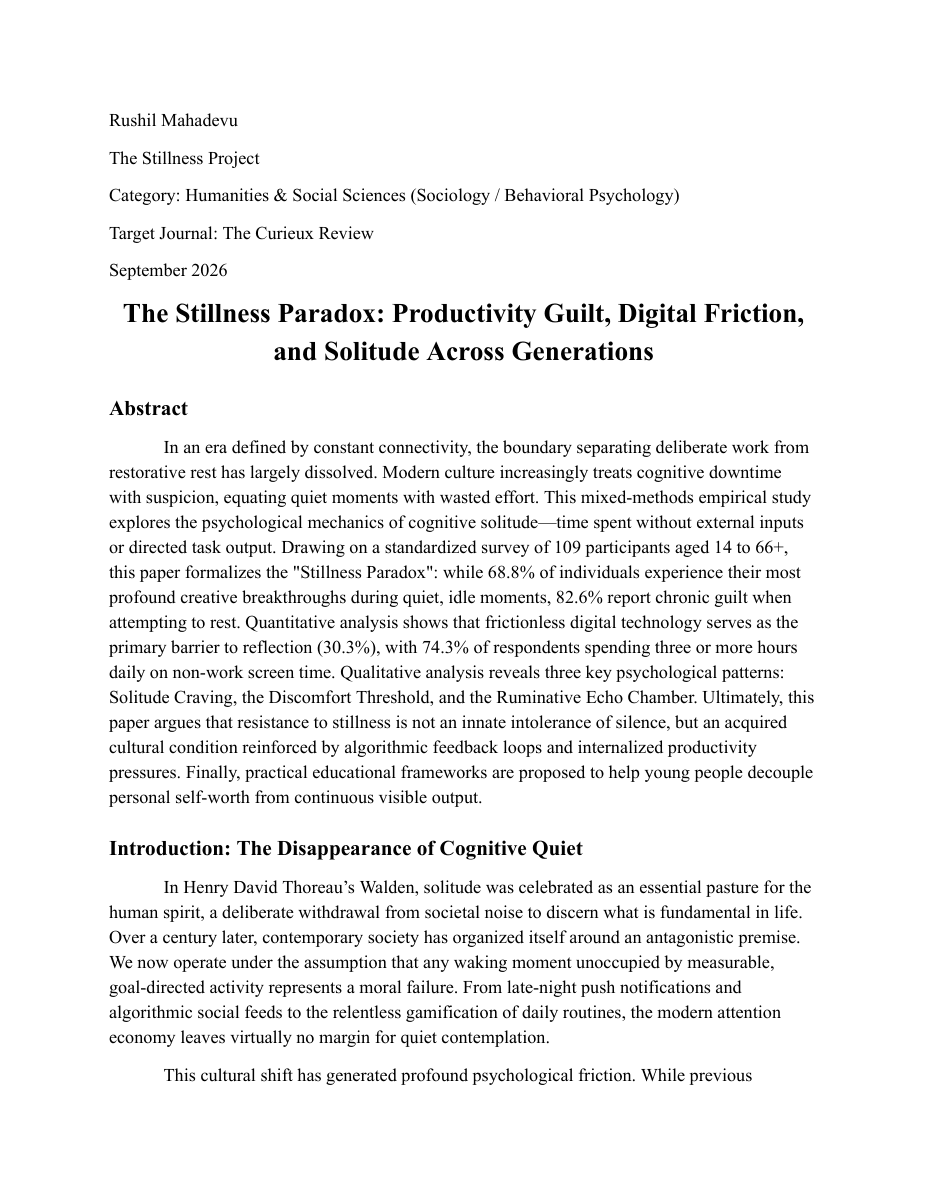
The Stillness Project explored how people experience quiet moments and the pressure to remain productive. A 23-question online survey gathered 109 responses, combining categorical questions and rating scales with open-ended reflections. In this sample, 82.6% reported productivity guilt at least sometimes, 73.4% reported three or more daily hours of non-work device use, and 68.8% recalled an important personal insight arising from stillness. The findings describe a tension between valuing quiet and making room for it. They are exploratory and do not establish causal relationships or population-wide patterns.
01. Research question
How do respondents experience stillness, and what makes quiet moments difficult to access? The project considered self-reported productivity guilt, device use, comfort with solitude, and personal reflections. It also explored differences in experience across age groups, while recognizing that the groups were unequal in size.
02. Method
The study used an online survey with 23 questions covering demographics, experiences of quiet, idea generation, productivity pressure, technology, and barriers to stillness. Quantitative responses were summarized descriptively; open-ended survey responses informed the written discussion of recurring themes. The completed study centers on survey data and does not include an interview component. The supplied manuscript reports data collection between July and September 2025.
03. Results
90 of 109 respondents (82.6%) reported guilt about not being productive sometimes, often, or almost always. 80 (73.4%) selected three or more daily hours of non-work device use. 75 (68.8%) reported that stillness had led to an important personal insight once or more. Technology/distractions was the most commonly selected biggest barrier (33 respondents, 30.3%), followed by guilt about not being productive (22, 20.2%).
04. Written reflections
The manuscript groups open-ended survey reflections around wanting quiet but deprioritizing it, feeling discomfort when stimulation stops, and encountering anxious or repetitive thoughts. These themes offer context for the numerical responses. They should be read as interpretations of written survey answers, rather than diagnoses, measured neurological effects, or findings from interviews.
05. Discussion
The responses suggest that valuing stillness and feeling comfortable with it are different experiences. Respondents described both practical obstacles and emotional resistance. This pattern motivates further research into quiet routines, digital habits, and attitudes toward rest. The survey does not test whether any particular intervention improves well-being or creativity.
06. Limitations
The sample is self-selected, the age groups are uneven, and all measures are self-reported. Only nine respondents were 51 or older. No experimental intervention, objective device tracking, or neurological measurement was conducted. Causal claims and claims of statistically significant generational differences are not supported by the descriptive results presented here.
Source & citation
Source: the supplied Curieux paper PDF and 109-row survey CSV. Only aggregate results appear on this site. The raw export includes contact information and is not offered as a public download.
Mahadevu, R. The Stillness Paradox: Productivity Guilt, Digital Friction, and Solitude Across Generations. The Stillness Project. Research manuscript.
The Curieux paper PDF includes the author’s literature references. No DOI, journal acceptance, or publication date is asserted here.